
How to Increase the Number of Tax Returns Your Firm Prepares in a Day
.png)
Short answer: Returns prepared per day rise across four levels, from manual work, to assisting AI, to tax-specific AI that files, to that platform running your workflows.
The four levels of tax return preparation capacity
You want more returns out the door, which means increasing the number of tax returns your firm prepares in a day. That is a fair goal, and this post answers it directly, whether you are sizing capacity for the extension season or evaluating an AI tax preparation tool for TY26.
Firms that raise returns prepared per day do it by moving up a ladder, and each rung removes a different category of work from the preparer. The rungs are manual preparation, AI that assists, tax-specific AI that files, and that same platform running your firm's own instructions. Each one raises the ceiling set by the one below it.
Instead's own practice puts a number on the top of that range. This past season a single staff member prepared 100 to 110 tax returns in a day. Read that precisely, because the precision is the point. It is one staff member, not a firm average. It raises the question that many in the industry are aiming to answer, what does tax preparation capacity per staff member look like when artificial intelligence is at the core of tax preparation and filing?
In today's world, there are many intelligence options available to firms, human, assisted, and agent-owned.
Tax preparation with no AI
At this level, the preparer handles all the coordination work, and that nonjudgmental work takes up most of the day.
Documents arrive through whatever channel the client prefers. The preparer opens each file to work out what it is, trusts or corrects filenames, assigns client and tax year by hand, and tracks the 28 document types across seven categories from memory. Last year's return gets manually pulled and read through to find recurring income sources, schedules filed, and carryforwards. Values are keyed into workpapers, and on a Partnership, per-partner amounts are calculated by hand across the workpaper. Missing documents and judgment calls are collected in one list. Structural tie-outs are run by hand if time allows, and under season pressure, they get skipped.
Where the hours go is the diagnosis. Very little of that list is tax judgment. It is reconstruction, classification, transcription, and chasing. Productivity stalls here because the scarce skill in the room is spending its day on work that does not require it, and the only ways to add capacity are hiring or overtime, both of which are slow and neither of which improves what arrives at review.
Tax preparation with AI
The common second step is AI, and it arrives in two shapes. Some firms build their own workflows on a general LLM assistant. Others buy a purpose-built tax AI product that sits on top of the tax engine they already run. Both are real improvements over preparing without AI, and both hit the same wall.
The wall is filing capability. A general LLM assistant can discuss a return but cannot compute it under a jurisdiction's rules or transmit it, because calculation capability and jurisdiction-specific e-file transmission approval are separate determinations, and a general tool has neither. The purpose-built tax AI products are better at the tax work and hit the same limit from the other direction. As of September 2026, across the tax AI products a firm is likely to evaluate, none file on its own government approvals. Each one requires the underlying tax engine to transmit the return.
Several of these products are very good at what they do. A dedicated scan-and-populate product can bring two decades of proven scale and strong data lineage, and we would not claim to beat it on that axis. The point is narrower. Adding one of these tools means adding a vendor to a stack that still needs the tax engine, and the filing path remains unchanged.
Two consequences follow, both of which bear on returns per day. The first is that the compliance obligations do not move. Provider obligations under IRS Publication 1345 and Publication 4163 sit outside the assisting tool entirely, so the firm still carries them. The second is where the reliability question sits. A general assistant produces instructions from general, unsourced knowledge rather than from reliable, trusted tax sources. Additionally, when building custom agents, the reliability of producing repeatable, structured work decreases. Its output is probabilistic, which is the wrong shape for a question that resolves by running an actual return.
Productivity does improve at this level, mostly on the writing, research, and document-handling edges of the job. What does not improve is the part of the day that ends in a filed return, because the tool that assists and the system that files are still two different things.
Tax preparation with Instead
The third rung closes the gap the second one leaves open. The work and the filing happen in the same system, on that system's own government approvals, across 1040, 1041, 1120, 1120-S, and 1065, federally today, with state and local coverage expanding as each jurisdiction's filing approval lands. Approval must be verifiable by form and jurisdiction; it should never be presented as government endorsement.
Instead is built for what a firm actually needs; there are eight capability areas in a tax practice. They are agentic AI, tax planning, tax research, tax estimates, tax workpapers, tax filing, tax preparation, and tax resolution. On legacy engines, producing this work requires separate tools or a subscription. These add-ons are limited or absent, which is why capability tends to appear as a separate line item. Instead includes all eight in one system with an agent at the center.
To understand how tax preparation and filing work in Instead, see how 1040 tax filing works in Instead, and it holds across entity types.
What AI tax preparation changes and what stays with the preparer
The honest comparison is not human against machine. It is one staff member working alone against the same staff member working with Instead.
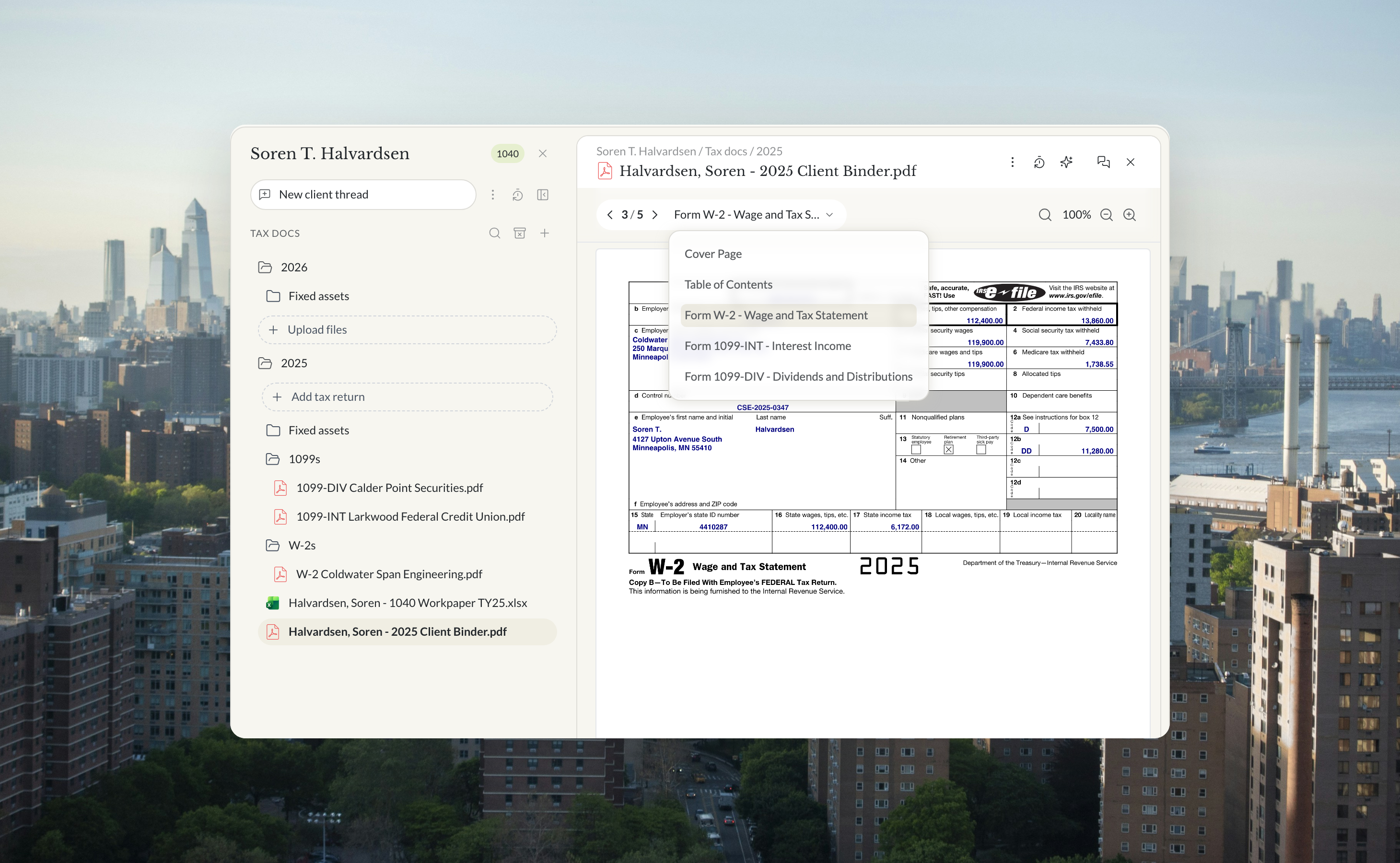
Some of the preparation mechanics see immediate productivity gains. Intake becomes classification rather than collection, values arrive in the workpaper carrying a reference back to the document and page that produced them, missing documents are separated from open questions, and structural tie-outs run before a human opens the file. On a Partnership, each K-1 line must sum across partners to the Schedule K total at zero tolerance and each partner beginning capital must reconcile to their prior-year ending capital. An Individual return draws on 28 document types across seven categories, and in Instead a Partnership workpaper runs to 18 tabs covering book-to-tax reconciliation, the balance sheet, and all supporting schedules. The table in the next section walks that comparison step by step.
What does not move is the part that carries responsibility. On an Individual return, the preparer confirms key taxpayer information such as filing status and dependents, makes judgment calls such as choosing between standard and itemized deductions, and makes elections. They resolve conflicts between documents and judge whether an activity is passive. They also determine each year whether a pass-through business is a specified service trade or business under the qualified business income rules of Internal Revenue Code Section 199A. That determination matters only once taxable income enters the phase-in range, since below that threshold the deduction applies regardless. On a Partnership, the preparer confirms which method, traditional, curative, or remedial, applies to built-in gain or loss on contributed property under Internal Revenue Code Section 704(c). They determine whether a special allocation satisfies substantial economic effect under Treasury Regulation 1.704-1(b). They also classify partners for self-employment income. Some of those matter because a wrong answer still passes the arithmetic. An incorrect Section 704(c) method changes per-partner amounts without changing Schedule K totals, so the allocation tie-out clears even when the split is wrong. No automation or intelligence replaces the judgment of the professional. Shifting the traditional model of reconstruction, moving it away from the preparer before preparation begins, increases preparation capacity. Raising filed-return capacity takes preparation that arrives at review already clearable, with evidence organized, sources cited, checks run, and open questions separated from missing documents.
One staff member alone versus working with Instead AI
The clearest way to see what AI changes in preparation is to benchmark against your firm's historical standard. Take one staff member and compare a day worked alone against the same day worked with Instead, step by step. The judgment stays in the same hands. What moves is the coordination work stacked around it, and that is what the single-day figure of 100 to 110 prepared returns reflects.
The core comparison is therefore not human against machine. It is human alone versus human plus Instead AI, the same staff member working without intelligence and then with it, and every line above moves coordination off the preparer while leaving the judgment exactly where it was. That is why the preparation figure climbs, and it is also why it is a preparation figure and not a filing figure, because none of these steps add review capacity.
Tax preparation with customized Instead
At the third level, the platform arrives with its own way of preparing a return. At the fourth, you write your firm's own preparation process in plain words, save it as a reusable workflow, and run it across your clients, so the platform runs your firm's process rather than you adapting to new software.
A firm builds a workflow by providing instructions in its own words that describe how it wants a piece of work done. The workflow is saved, named, and editable, and it can be shared with the firm so it is available to the people who need it rather than living in one person's head. Instead's own workflows and the firm's sit alongside each other, and a firm can create and manage its workflows in one place, then run them for individual clients.
Running is where the shape of the work changes. A firm can select multiple clients, start a single run, and the workflow is dispatched to each selected client's workspace, delivering client-specific results. The staff member is no longer working one return at a time, they are launching work across a book of clients.
The firm workspace holds this together. A user opens a client or entity without leaving the firm workspace, with navigation, chat, planning, prep, documents, and threads staying within reach, so moving across a book of clients does not mean reassembling context each time.
This rung is worth stating precisely. The customization here is instruction-writing rather than structured configuration. You write your firm's process in your own words, then re-run it, and the agent helps you build custom workflows.
That is the level in its real shape. It is the difference between using a tax platform and having your firm's way of working be the thing the platform runs.
What caps returns per day, and how to size the payoff
Four variables move review load, and they compound. A firm modeling its own capacity should walk them in this order.
Return type and complexity. A straightforward 1040 and a multi-state 1065 with tiered partners are not the same unit of work and should never be averaged into one number. Any per-day figure is meaningless without the return mix behind it.
Source document quality. Complete, legible, correctly attributed documents produce a return that reviews quickly. Reconstructed or partial documentation produces open items, and open items are reviewer time. This is the variable most within a firm's control and the one most often ignored in capacity planning.
Review labor model. Whether every return gets full review, or review is risk-tiered by complexity and preparer track record, changes total capacity more than any preparation improvement. Two firms with identical preparation productivity and different review models have materially different output.
Batch and queue management. Returns arriving in usable batches keep reviewers working. Returns arriving in bursts against unpredictable client responsiveness leave reviewers idle and then overloaded. Queue discipline converts nominal capacity into real capacity.
Five questions for any AI tax preparation productivity claim
- What return mix produced the number, and how much of it resembles our client base?
- Does it count prepared returns or filed returns?
- What review model is assumed, and does it match ours?
- What document quality is assumed at intake?
- Over what time window, and does it include peak-season conditions or an average day?
A vendor who cannot answer these is quoting a number from conditions that may not resemble your firm. A number without its return mix, review model, and time window is not a capacity figure.
How to model your firm's tax return capacity
You do not need a software-built model to determine where your return productivity stands. You can run the arithmetic in a planning meeting.
Filed-return capacity = total reviewer minutes available in the window ÷ weighted average review minutes per return
For example, let's say there are four reviewers with 500 usable review hours across the window, which is 30,000 review minutes. Its mix is 70 percent straightforward 1040s and 30 percent entity returns. Under uniform review, every return takes 20 minutes, so capacity is 1,500 filed returns. Now hold preparation, reviewers, and mix constant, and change only the review model. Risk-tier the work so low-risk 1040s take 8 minutes, and entity returns still take 40. The weighted average falls to about 17.6 minutes, and capacity rises to roughly 1,705 filed returns. Nothing changed except how the returns were reviewed, and that alone moved output.
How do you increase returns per day with Instead
The Instead AI tax platform runs intake, workpapers, return population, review findings, and filing as one path, which is what puts a return in front of a reviewer already clearable rather than merely finished.
The number that matters is not how fast returns are prepared but how many your firm can review and file. If you are at capacity this extension season or sizing headcount for TY26, book a capacity planning session and we will map your return mix and review model to where your productivity actually binds.
Frequently asked questions
Q: Can a general AI assistant like ChatGPT file a tax return?
A: No. A general assistant can discuss a return, draft correspondence, and explain a rule, but it can neither compute a return against a jurisdiction's rules nor hold e-file transmission approval. Those are separate determinations, and a general tool holds neither. The return still has to be prepared and transmitted by a system that carries the approvals, and the provider obligations stay with the firm.
Q: What is the difference between using Instead pre-built workflows and customizing it to your firm?
A: Using Instead means the platform prepares and files on its own government approvals, following its own process. Customizing it means your firm writes its own workflow as instructions in plain words, saves it, shares it with the firm, and runs it across many selected clients at once, with the work dispatched to each client's workspace. The first gives you a tax-specific system that files. The second makes that system run your firm's process rather than a generic one.
Q: What return types see the biggest productivity gains?
A: Returns where the work is weighted toward document handling and reconstruction rather than judgment. High document volume with clean structure benefits most. Returns dominated by novel positions or unusual structuring benefit least, because the constrained work is judgment, which does not shift.
Q: Can I apply the 100 to 110 returns a day figure to my firm?
A: Not directly, and the framing is the reason. It describes one staff member in a standout instance, not a rate to plan against. It is also a preparation figure, and a prepared return is not a filed return. Use it as evidence of what preparation looks like when coordination work is automated, then model your own productivity increases from your review capacity, which is the real constraint.
Q: Can we increase productivity without adding reviewers?
A: Yes, within limits. Reducing per-return review time through better intake, risk-tiered review, and fewer open items raises filed-return capacity without new headcount. The gain is real but bounded, because review remains the ceiling once preparation is fast.
Q: How does this apply to Partnership and Corporation returns?
A: The ladder is the same and the gains are usually larger. Entity returns carry entity-level detail, allocations, and multi-state considerations that make reconstruction a bigger share of the work, so moving that work off the preparer matters more. The judgment items, method selection and allocation testing among them stay with the preparer at every level.
Q: Does an AI-prepared return change e-file authorization?
A: No. Signature authorization and provider obligations are unchanged by how the return was prepared. An Individual return still requires Form 8879, the IRS e-file signature authorization the electronic return originator must obtain from the taxpayer, signed and dated, before transmitting the return, and keep for three years from the return due date or the IRS received date, whichever is later. A Partnership return requires Form 8879-PE. Provider requirements for Individual returns, including electronic filing identification number obligations, come from IRS Publication 1345, and Partnership provider obligations from IRS Publication 4163. Calculating a return and being approved to transmit it to a given jurisdiction are separate determinations, and neither is a productivity variable.

The Destruction of the Billable Hour: AI's Impact on Accounting Firm Pricing in 2027

Year-End Tax Planning 2026: Checklist of Strategies by Dec 31

How AI Tax Orchestration Works in Instead




.png)